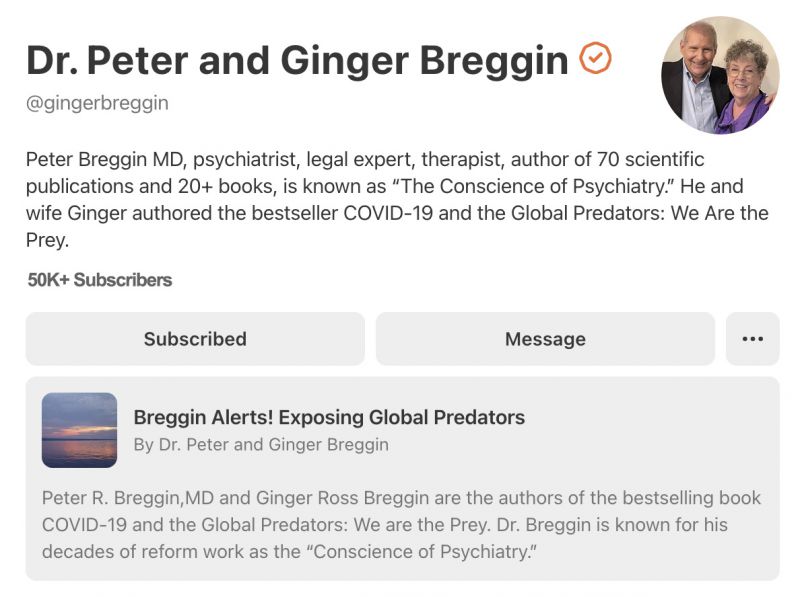
Peter R. Breggin, MD, has been called "The Conscience of Psychiatry" for his efforts to reform the mental health field. He has created a new organization to bring together professionals and laypersons concerned with a critical analysis of biopsychiatry and with more effective empathic approaches in mental health and education.


The upcoming Empathic Therapy Conference will be held in Syracuse, New York State, April 13-15, 2012. Public is welcome.


      A Harvard-trained psychiatrist and former full-time consultant at NIMH, Dr. Breggin's private practice is in Ithaca, New York, where he treats adults, couples, and families with children. He is the author of dozens of scientific articles and more than twenty books including Medication Madness: The Role of Psychiatric Drugs in Cases of Violence, Suicide and Crime (2008).


      Dr. Breggin often acts as a medical expert in criminal, malpractice and product liability suits. A recent precedent-setting case in Canada was based on Dr. Breggin’s testimony and written report. On September 16, 2011 in Winnipeg, a Provincial judge concluded that Prozac caused a sixteen-year-old boy to knife a friend to death (read more).


      In the early 1990s Dr. Breggin was appointed and approved by the court as the single scientific expert for more than 100 combined Prozac product liability concerning violence, suicide and other behavioral aberrations caused by the antidepressant. In 2001-2002, he participated as a medical expert in a California lawsuit whose resolution was associated with a new label warning for Paxil concerning withdrawal effects.


      Recently Dr. Breggin was the medical expert in the first psychosurgery malpractice suit and also the first ECT malpractice suit ever won in court. He has been a medical expert in many courtroom victories for individuals injured by medications, including numerous cases of tardive dyskinesia caused by neuroleptic drugs.


      Dr. Breggin has also been a consultant to the Federal Aviation Agency (FAA) on the adverse effects of psychiatric drugs on pilots.

More information on Dr. Breggin.


Sign Up for Dr. Breggin's New Organization and Conference


Special Topics

Legal Cases


Dr. Breggin often acts as a medical expert in criminal, malpractice and product liability suits, and since the 1970s has testified in approximately 100 trials. However, most of the cases he accepts are settled before going to court.

Read more...
 

Therapy

 
Blunting ourselves with drugs is not the answer to overwhelming emotions. Intense emotions should be welcomed. Emotions are the vital signs of life. We need and should want them to be strong. We also need our brains and minds to be functioning at their best, free of toxic drugs. That allows us to use our intelligence and understanding to the fullest. Thinking clearly is one of the hallmarks of taking charge of oneself instead of caving in to helplessness. 
 
Read more...
 

Children


Throughout his career, Dr. Breggin has been especially concerned about the psychiatric abuse of children and the failure to provide more effective solutions through improved parenting, educational reform and community resources. As the drug companies and organized psychiatry have sought larger markets for pharmaceutical products, children have come under extensive from the psychopharmaceutical complex. The first great assault took place in the form of diagnosing children with ADHD and then medicating them with stimulant drugs. Soon millions of children were defined as mentally dysfunctional or defective and were submitted to brain-damaging psychoactive medications.


Read more...
 

ECT

By far the most up-to-date information of the dangers associated with ECT can be found in a chapter in Dr. Breggin’s book, Brain-Disabling Treatments in Psychiatry: Drugs, Electroshock and the Psychopharmaceutical Complex, Second Edition (2008). Dr. Breggin brings together and evaluates dozens of articles demonstrating permanent brain damage from ECT including irreversable severe memory loss and wide spread cognitive disabilities. Many patients lose their ability to practice their professions or to conduct their lives in a normal fashion. Dr. Breggin was the medical expert in the first and only electroshock malpractice suit won by the injured patient. He was also the expert in a recent malpractice suit against an ECT doctor that resulted in a settlement of more than $1 million.


The acronym ECT stands for "ElectroConvulsive Therapy" (also called EST, for ElectroShock Therapy)  a psychiatric treatment in which electricity is applied to the head and passed through the brain to produce a grand mal or major convulsion. The seizure brought about by the electric stimulus closely resembles, but is more rigorous or strenuous than that found in idiopathic epilepsy or in epilepsy following a wide variety of insults to the brain.
 
Patients given ECT are administered an electric current of sufficient intensity and duration to produce an acute organic brain syndrome, characterized by the classic symptoms of disorientation to time, place, and person; mental deterioration in all intellectual spheres such as abstract reasoning, judgment, and insight; emotional lability with extremes of apathy or euphoria; and overall childlike helplessness.

Read more...
 

Psychosurgery

 
Psychosurgery is the destruction of normal brain tissue for the purpose of treating psychiatric disorders or for the control of emotions and behavior.  It does not include operations, such as those for Parkinson's disease or epilepsy, where an identifiable physical abnormality in the brain is causing a known physical disorder.  
 
Lobotomy and other psychosurgeries merit special attention because, as the prototype of brain-damaging therapeutics, they can shed light on the clinical effects of other brain-disabling treatments such as electroconvulsive therapy (ECT) and major tranquilizers. Despite the paucity of active practitioners and advocates of psychosurgery, many psychiatric authorities have condoned this treatment precisely because the principles that find their extreme expression in lobotomy and other forms of psychosurgery also find more subtle expression in all the major somatic treatments in psychiatry.
 
Read more...
 

Racism & Social Control


The widespread diagnosing of children is a subtle form of social control that suppresses children rather than providing them with what they need to fulfill their basic needs in the home, school and family.  For more information about social control and youngsters see the Children's section under Special Topics and Children's section under Scientific Papers, and well as several of Dr. Breggin's books, especially Brain-Disabling Treatments in Psychiatry (1998).  Dr. Breggin's blogs often address current children's issues.

 
In Toxic Psychiatry (1991) Dr. Breggin addresses the psychiatric oppression of women.

See Dr. Breggin's astonishing speech on Totalitarian Psychiatry & the Nazi Holocaust.

Both Peter Breggin and Ginger Breggin have worked extensively to stop racist psychiatric programs of social control, especially those aimed at subuding inner city children. These successful reform projects are described in detail in their book, The War Against Children of Color (1998).   The following article is based on the book and presents a summary of their efforts. 

 
Read more...


Peter R. Breggin, MD is no longer affiliated with the Center for the Study of Psychiatry, informally known as International Center for the Study of Psychiatry and Psychology (ICSPP changed to ISEPP), which he founded and led from 1972-2002, and Dr. Breggin is no longer involved in its conferences. Dr. Breggin and his colleagues have founded a new organization, The Center for the Study of Empathic Therapy, Education and Living (a 501C3) which holds its annual conference in April of each year (www.empathictherapy.org).


WARNING!

Most psychiatric drugs can cause withdrawal reactions, sometimes including life-threatening emotional and physical withdrawal problems. In short, it is not only dangerous to start taking psychiatric drugs, it can also be dangerous to stop them. Withdrawal from psychiatric drugs should be done carefully under experienced clinical supervision. Methods for safely withdrawing from psychiatric drugs are discussed in Dr. Breggin's books, Brain-Disabling Treatments in Psychiatry: Drugs, Electroshock and the Psychopharmaceutical Complex (New York: Springer Publishing Company, 2008) and Medication Madness: The Role of Psychiatric Drugs in Cases of Violence, Suicide and Crime (New York: St. Martin's Press, 2008).